


Palm Sliders in Motorcycle Gloves: What They Do, What They Don’t, and Why Racers Use Them
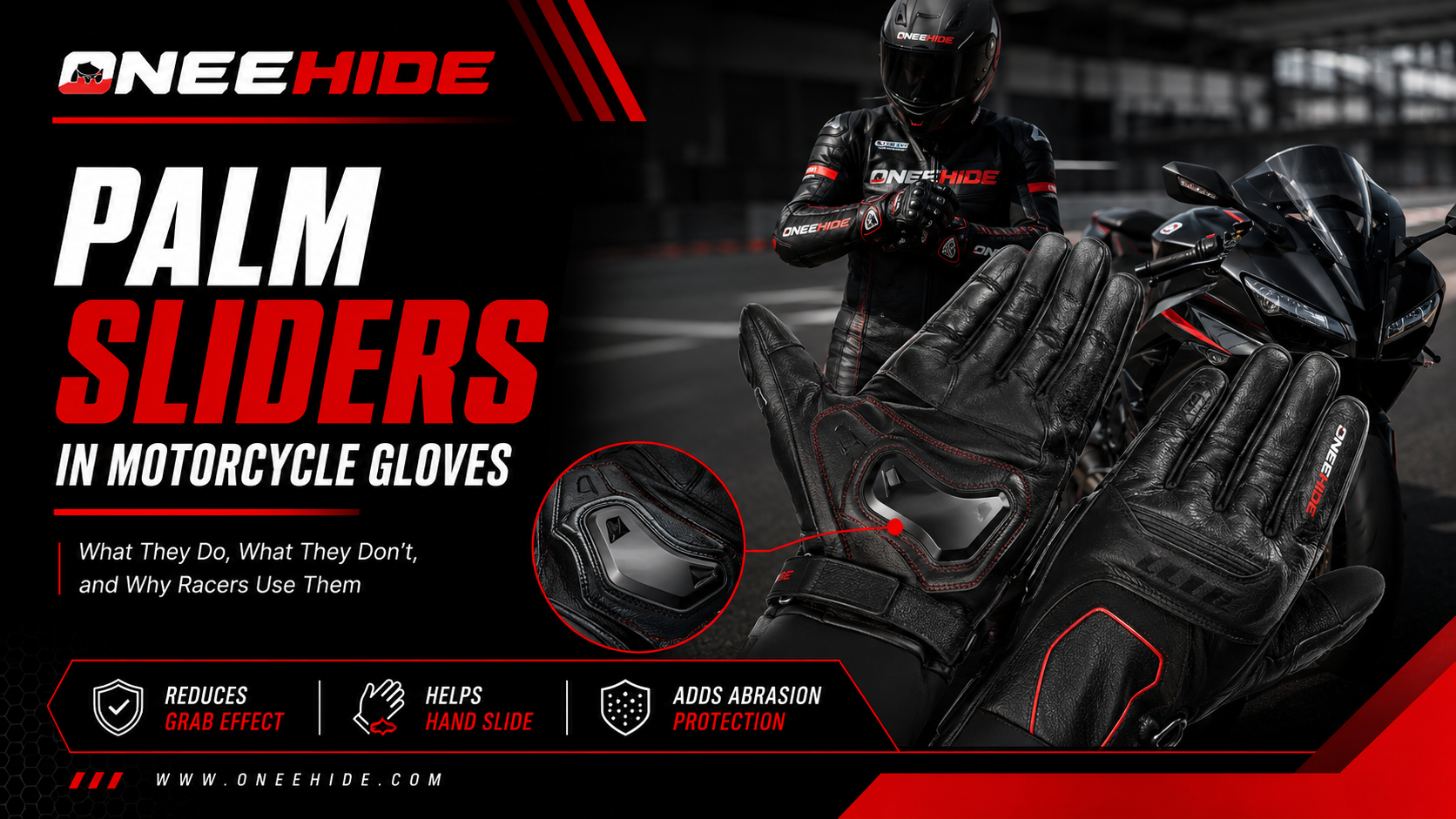
A motorcycle glove can be extremely abrasion resistant and still behave badly when the palm hits pavement. The problem is not only whether the material survives contact with the road. It is also what happens when the rider’s hand suddenly grips the surface instead of continuing to slide.
That is the purpose behind palm sliders. These hard or semi-rigid sections are positioned over likely contact zones on the palm to manage friction during a crash. Rather than allowing leather or another high-friction palm material to catch aggressively on asphalt, the slider is intended to help the hand continue moving across the surface.
That sounds simple, but palm sliders are often misunderstood. They are not a guarantee against wrist or scaphoid injury, they do not replace a well-constructed glove, and the presence of a plastic piece on the palm says little about the glove’s overall protective performance.
Understanding what a palm slider can and cannot do makes it easier to judge racing gloves on their complete design rather than one visible feature.
What Does a Palm Slider Actually Do?
A palm slider is primarily a friction-management and abrasion-management component.
During many falls, riders instinctively put a hand toward the ground. If the palm contacts the road while the body is still moving, a relatively grippy surface can catch abruptly. The rider’s arm and body may continue traveling while the hand decelerates much faster.
A low-friction slider attempts to change that interaction. Instead of the palm grabbing the road immediately, the hard surface is designed to skid across it.
The intended benefits are closely related:
-
Reducing the tendency of the palm to catch suddenly on pavement
-
Allowing the hand to slide more freely during road contact
-
Providing an additional abrasion layer over a vulnerable landing zone
-
Reducing direct wear on the leather or textile underneath
-
In some designs, helping manage heat generated during a slide
This is why the feature appears so frequently on serious sport and racing gloves.
A rider comparing track-focused riding gloves should therefore look at the palm slider as one component within a broader protection system that also includes abrasion-resistant materials, strong seams, wrist retention, impact protection and proper fit.
The “Grab Effect” Palm Sliders Are Designed to Address
The central idea behind many palm-slider systems is sometimes described as reducing the grab effect.
Consider a rider sliding across asphalt with an outstretched hand. The rider and arm have forward momentum. If the palm suddenly catches, the hand can become a temporary anchor point while the rest of the body continues moving.
That can load the wrist in ways that a simple abrasion pad does not address.
The scaphoid receives particular attention because it is a small carpal bone on the thumb side of the wrist. However, describing a slider as a “scaphoid protector” can create the wrong mental picture. Most palm sliders are not simply rigid shields placed directly over a bone to stop an impact.
Their protective concept is often more mechanical: reduce friction at the palm so that the hand is less likely to stop abruptly and force the wrist into excessive extension or rotation.
Knox, which developed its Scaphoid Protection System, describes its design as two low-friction palm components intended to reduce the grabbing action that can occur when a leather palm contacts the road. The company currently produces versions using abrasion-resistant LDPE and, in some designs, combines the sliding shells with impact-absorbing material underneath. Knox Scaphoid Protection System technical information
The distinction matters. A surface engineered to slide and a material engineered to absorb impact perform different jobs, although manufacturers can combine both functions in the same assembly.
Why Palm Sliders Are So Common on Racing Gloves
Palm sliders make particular sense in track-oriented gloves because racing equipment has to manage the possibility of high-energy contact while preserving very precise control feel.
A racer cannot simply wear an extremely thick, heavily padded glove. The hand still has to modulate the throttle, operate the front brake, work the clutch and maintain feedback through the handlebar.
Designers therefore have to protect high-risk zones without making the entire palm unnecessarily bulky.
A localized slider helps address that compromise.
Current racing-glove designs illustrate the approach. Alpinestars, for example, equips its GP Pro R4 racing glove with a hard palm slider along with finger sliders, aramid reinforcement, impact-absorbing layers, a finger bridge and a dual wrist-closure system. The manufacturer specifically describes the palm and finger sliders as increasing abrasion resistance and helping limit heat transfer during sliding. Alpinestars GP Pro R4 technical specifications
That combination illustrates an important principle: racing gloves rarely depend on one protector.
The slider addresses one crash mechanism. Other construction elements address different ones.
A strong race glove may need to deal with:
-
Initial impact with the road
-
Abrasion during continued sliding
-
Seam failure
-
The glove being pulled off the hand
-
Fingers being twisted or separated
-
Knuckle contact
-
Palm abrasion
-
Wrist loading
No single palm component can solve all of those problems.
Palm Sliders Are Not a Guarantee Against Broken Wrists or Scaphoids
One of the biggest mistakes riders can make is interpreting a palm slider as a promise that a wrist or scaphoid fracture cannot occur.
Crash mechanics are much more complicated.
The hand may strike the ground outside the protected zone. The wrist may experience a direct impact. The rider can collide with another motorcycle, a curb, barrier or other object. Fingers can catch independently of the palm. The glove may move on the hand if its retention system is poor.
Even the broader evidence on motorcycle gloves supports a cautious interpretation.
A study of 226 motorcycle-crash patients found that riders wearing gloves experienced substantially fewer hand soft-tissue injuries in that dataset. Hand soft-tissue injuries were recorded in 44.7% of glove users compared with 80.0% of riders without gloves. However, the study did not find a statistically significant reduction in hand or wrist fractures among glove users. published motorcycle protective-clothing study
That research evaluated glove use generally, not palm-slider effectiveness specifically, so it cannot tell us whether a particular slider prevents a particular fracture. What it does demonstrate is why protective claims need to remain realistic.
Gloves can reduce some forms of injury without making the hand or wrist invulnerable.
The more accurate description is that a properly designed palm slider may help manage a specific mechanism associated with road contact. It lowers one category of risk rather than eliminating crash injuries.
A Palm Slider Does Not Replace Abrasion-Resistant Construction
It is easy to focus on a visible hard protector and overlook the materials surrounding it.
That would be a mistake.
During an actual slide, the hand may rotate. Different parts of the palm, fingers and side of the hand can contact the road. A small slider cannot protect every possible contact area.
The underlying glove construction still matters enormously.
EN 13594:2015, the European standard for protective motorcycle gloves, evaluates characteristics including ergonomics, mechanical properties, impact protection, restraint and abrasion performance. It establishes Level 1 and Level 2 performance classifications rather than treating one particular visible component as proof of protection.
The palm abrasion requirements show how significant the underlying construction is. Under the standard's impact-abrasion testing, Level 1 requires a mean abrasion time of at least 4 seconds, with individual results of at least 3 seconds. Level 2 raises those figures to a mean of at least 8 seconds and individual results of at least 6 seconds.
Those laboratory times should not be translated directly into an expected number of seconds that a glove will survive every real crash. Road surfaces, speed, pressure, tumbling, debris, impact angles and contact zones vary enormously.
They are standardized comparative performance requirements, not crash-duration guarantees.
For a buyer, the practical lesson is more useful: examine the entire palm construction rather than asking only whether a slider is present.
What Separates a Useful Palm Slider From a Decorative One?
Two gloves can both advertise “palm sliders” while using very different designs.
The first thing to examine is placement. The slider should cover a realistic landing or sliding zone without interfering with the rider’s natural grip on the handlebar.
Next is integration. A hard component attached poorly to weak material does not automatically create a strong glove. The surrounding leather or textile, stitching and reinforcement must survive the forces transmitted through that area.
Then consider the slider's relationship with impact protection. Some designs are primarily low-friction shells. Others combine a hard sliding surface with foam or another energy-absorbing layer underneath.
Those configurations should not be assumed to perform identically.
Fit is equally important. A protective element can only remain where the designer intended if the glove fits correctly and remains securely attached to the hand.
A good evaluation should therefore ask:
-
Does the slider sit over a likely palm landing zone?
-
Does it interfere with throttle, brake or clutch operation?
-
Is the surrounding palm reinforced?
-
Are the main seams positioned and constructed sensibly?
-
Is there padding beneath or around the hard protector?
-
Does the glove have a secure wrist-retention system?
-
Does the glove remain firmly located when the hand is pulled?
-
Has the complete glove been independently certified to a recognized motorcycle-glove standard?
This produces a much better picture of protection than simply counting pieces of TPU or plastic.
Why Wrist Retention Matters Alongside the Palm Slider
A technically impressive slider becomes much less useful if the glove leaves the rider’s hand during the crash.
That is why race gloves commonly use a separate wrist retention strap in addition to the closure around the gauntlet.
EN 13594 also treats restraint as a measurable part of glove performance. The standard requires a retention system and applies different performance thresholds for its two protection levels.
This illustrates how motorcycle hand protection works as a system.
The palm must resist abrasion. The glove needs to stay attached. Seams need to remain intact. The rider still needs dexterity. Knuckle areas may require impact attenuation. High-risk landing zones can then receive additional reinforcement or sliding surfaces.
Removing any one of those considerations can create a weak point regardless of how impressive the other components look.
For track use in particular, riders should evaluate the glove as a complete protective structure rather than shopping for a single headline feature.
Should Every Rider Choose Gloves With Palm Sliders?
A well-designed palm slider is a meaningful feature, particularly for riders who prioritize sport or track protection, but its presence should not automatically decide which glove to buy.
Street, touring and racing gloves face different compromises.
A race glove can accept a larger gauntlet, more external protection and a more complex retention system because maximum convenience is not its primary design goal. A daily commuter may place greater value on weather resistance, easy removal and flexibility. Touring riders may need waterproofing and long-duration comfort that changes how the entire glove is constructed.
None of those priorities makes friction management irrelevant.
Instead, the useful question is whether the slider has been incorporated into a glove that fits the intended riding environment.
For track-focused use, prioritize the complete package: secure retention, strong palm and seam construction, suitable certification, good control feel, coverage of likely impact zones and a properly integrated low-friction palm protector.
A palm slider is most valuable when it does exactly what its name suggests: helps the hand slide rather than suddenly grab the road. Its real strength comes from being combined with everything else the glove needs to do once that slide begins.

 English