


How to Manage Complex Subscription Pricing and Billing Scenarios
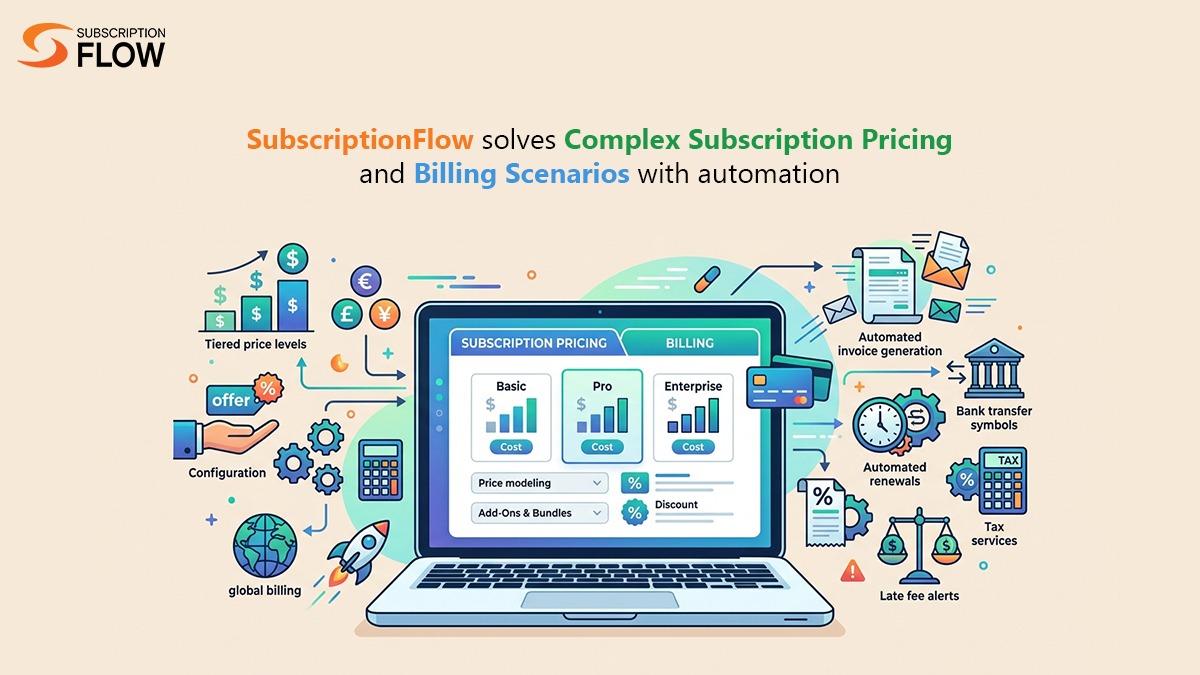
Subscription businesses often begin with a simple pricing structure. A company may launch with a single plan, a straightforward monthly fee, and a basic billing process. However, as the business grows, customers demand more flexibility, and companies introduce additional plans, usage-based pricing, add-ons, discounts, regional pricing, and customized contracts. What once seemed like a simple billing operation can quickly become a complex system that requires careful management.
Complex subscription billing is not necessarily a problem, but unmanaged complexity can become one. Manual calculations, disconnected systems, inconsistent pricing rules, and poorly handled billing exceptions can result in invoice errors, revenue leakage, payment failures, and customer dissatisfaction. The key is to establish clear billing policies and use automation to ensure that pricing and billing rules are applied consistently.
What Makes Subscription Pricing Complex?
Subscription pricing is different from traditional one-time purchasing because the customer relationship continues over time. During that relationship, pricing, usage, products, payment methods, and contract terms can all change. A customer might upgrade their plan halfway through a billing cycle, add additional users, consume more services than expected, receive a promotional discount, or change their payment currency.
Businesses can also operate multiple pricing models simultaneously. Flat-rate, tiered, per-user, usage-based, and hybrid pricing models may all exist within the same product portfolio. As these models interact, billing calculations become increasingly difficult to manage manually. A single invoice may contain a recurring subscription charge, usage-based fees, discounts, taxes, add-ons, and prorated adjustments.
Managing Usage-Based and Hybrid Pricing
Usage-based pricing has become increasingly popular because it allows businesses to charge customers according to the value they consume. Instead of paying a fixed amount regardless of usage, customers may be billed according to API calls, transactions, storage, minutes, or other measurable units.
The challenge is ensuring that usage data is accurate and properly associated with the correct customer and billing period. A reliable billing system needs to capture usage events, prevent duplicate records, apply allowances and thresholds, calculate overage charges, and aggregate usage according to defined rules.
Hybrid pricing introduces another layer of complexity because it combines a recurring base subscription with variable usage charges and potentially additional products or services. For example, a customer might pay a fixed monthly platform fee while also being charged for the number of transactions processed. Automating these calculations helps businesses generate accurate invoices without relying on spreadsheets or manual reconciliation.
Handling Discounts, Promotions, and Special Offers
Promotional pricing is an important acquisition and retention strategy, but discounts can become difficult to manage as a business introduces more campaigns and customer segments. Time-limited promotions, percentage discounts, fixed-amount coupons, volume discounts, referral incentives, and loyalty offers all require clearly defined rules.
Businesses need to determine when a discount begins, when it expires, whether multiple promotions can be combined, and what happens when the promotional period ends. Without automation, expired discounts can continue to be applied or different customers can receive inconsistent pricing.
A centralized billing system can apply promotional rules automatically. This ensures that customers receive the correct discount while allowing finance and revenue teams to maintain better control over pricing.
Automating Upgrades, Downgrades, and Proration
Customers frequently change their subscriptions. They may upgrade to access additional features, increase the number of seats, downgrade because their requirements have changed, or add a new service in the middle of a billing period.
These changes require accurate proration. The billing system must determine how much of the existing subscription remains unused, calculate the value of the new subscription for the remaining period, and determine whether the resulting adjustment should be charged immediately or included on the next invoice.
Businesses should establish their proration policies in advance. For example, upgrades might take effect immediately with a prorated charge, while downgrades could become effective at the next renewal date. Clear policies combined with automated calculations reduce billing disputes and prevent both overcharging and revenue leakage.
Creating Better Trial and Introductory Pricing Experiences
Free trials and introductory offers can reduce the barrier to acquiring new customers, but they also introduce additional billing requirements. A subscription system needs to know exactly when a trial begins and ends and what should happen when the trial expires.
Businesses also need to distinguish between trials that require a payment method and those that do not. Introductory pricing can add another layer of complexity when customers receive a discounted rate for the first few billing cycles before automatically moving to the standard price.
Automating these transitions ensures that customers move from trial to paid subscription at the correct time and that promotional pricing ends without requiring manual intervention. Trial extensions should also be supported so sales and customer success teams can accommodate exceptional situations without disrupting the billing schedule.
Managing Multiple Subscriptions and Add-Ons
As businesses expand their product offerings, customers may purchase multiple subscriptions or combine a primary plan with several add-ons. Managing these products separately can create unnecessary billing complexity.
A centralized subscription management system can consolidate multiple charges into a single invoice while still maintaining the relationships between individual subscriptions and add-ons. It can also support independent billing cycles, prorated add-ons, bundled pricing, and dependencies between products.
This becomes particularly important for enterprise customers that may have multiple departments, products, locations, or contracts operating under the same customer account.
Managing Global Billing, Currency, and Taxes
International expansion creates another set of subscription billing challenges. Businesses selling across different countries must account for multiple currencies, tax requirements, payment methods, and regional pricing strategies.
Tax rules can vary significantly depending on the customer's location and the type of product being sold. Businesses may need to calculate VAT, GST, sales tax, or other applicable taxes while maintaining accurate records for reporting and compliance.
Multi-currency billing also requires businesses to determine how exchange rates are handled and how revenue is reported in the company's base currency. A billing platform with multi-currency and tax capabilities can automate much of this process and reduce the risk of calculation errors.
Reducing Revenue Loss From Failed Payments
Payment failures are an unavoidable part of subscription commerce. Cards expire, payment methods are declined, accounts may have insufficient funds, and customers can encounter temporary banking issues.
Simply canceling a subscription after the first failed payment can result in unnecessary revenue loss. Instead, businesses should implement automated retry and dunning strategies. Failed payments can be retried at appropriate intervals while customers receive automated notifications explaining the issue and directing them to update their payment information.
Grace periods can also allow customers to resolve payment problems without immediately losing access to the service. Tracking involuntary churn separately from voluntary cancellations gives businesses a clearer understanding of how much revenue is being lost because of payment failures.
Improving Invoices, Credits, Refunds, and Adjustments
Even highly automated billing environments will occasionally require adjustments. Customers may request refunds, billing errors may need to be corrected, or a business may want to issue a credit following a service disruption.
Accurate, itemized invoices make these situations easier to resolve. Customers should be able to clearly understand their base subscription charges, usage fees, discounts, taxes, credits, and other adjustments.
Credit notes and partial refunds can also provide a more precise way to correct billing issues without unnecessarily reversing an entire invoice. Most importantly, adjustments should be recorded in an auditable manner so finance teams can maintain accurate accounting records.
Keep Billing Logic Separate From Product Development
One of the most effective ways to manage billing complexity is to separate billing logic from the core product. When pricing rules are hardcoded directly into an application, every pricing change can require engineering resources and a new deployment.
A dedicated billing engine allows pricing teams to introduce new plans, change rates, configure discounts, and create new billing rules without modifying the underlying product. This approach also gives businesses greater flexibility when experimenting with new monetization strategies.
Build Reliable Usage Metering
For businesses using usage-based pricing, accurate metering is essential. Every usage event should be uniquely identifiable so that repeated events do not accidentally result in duplicate charges.
Businesses should also define how usage is aggregated. Depending on the product, billing may be based on total consumption, maximum usage, distinct events, or another measurement over a specific period.
Late-arriving usage data is another important consideration. Companies should establish rules for handling events that arrive after a billing period has closed. A clearly defined process prevents unexpected invoice adjustments and customer disputes.
Automate Proration and Co-Terming
Enterprise customers often make subscription changes during an existing contract. They may add seats, purchase additional services, or modify their subscription before the contract ends.
Automated proration calculates the cost of these changes for the remaining period. Co-terming can then align new products or seats with the customer's existing renewal date. Instead of creating multiple invoices and renewal dates, businesses can consolidate billing around a single contract timeline.
This creates a cleaner experience for customers while making account management easier for finance and customer success teams.
Support Revenue Recognition Requirements
Billing and revenue recognition are not the same thing. An invoice may represent money that has been billed or collected, but accounting standards generally require revenue to be recognized as the related performance obligations are satisfied.
For subscription businesses, this distinction becomes particularly important when contracts include prepaid annual subscriptions, setup fees, usage-based charges, discounts, and other components.
Businesses should therefore ensure that their billing infrastructure can provide the necessary data for revenue recognition and support accounting processes under applicable standards such as ASC 606 and IFRS 15.
Best Practices for Complex Subscription Billing
The best approach to complex billing is to establish policies before problems occur. Businesses should clearly define how they handle upgrades, downgrades, prorations, refunds, discounts, failed payments, and billing adjustments.
Billing logic should also be centralized rather than distributed across spreadsheets, custom application code, and payment processor settings. Automation should be used wherever possible to reduce manual calculations and minimize human error.
Customer visibility is equally important. Providing customers with access to usage information, upcoming charges, and clear invoices can reduce billing surprises and support requests. Regular audits of pricing, invoices, discounts, taxes, and payment recovery processes can also help identify problems before they become significant.
Finally, businesses should think about scalability when selecting their subscription infrastructure. Even if a company currently operates in one market with a relatively simple pricing model, future expansion may require multi-currency billing, additional products, usage-based pricing, and more sophisticated tax management.
The Future of Complex Subscription Billing
Complex Subscription billing will continue to experiment with new monetization models as customer expectations and competitive pressures evolve. Usage-based pricing, hybrid plans, personalized offers, flexible contracts, and multiple product bundles are likely to create even more sophisticated billing requirements.
The businesses that manage this complexity successfully will be those that combine clear pricing policies with flexible technology and automation. Instead of relying on manual processes to keep up with an expanding product catalog, companies can use subscription management and billing platforms to automate calculations, payments, invoicing, and revenue operations.
Platforms such as SubscriptionFlow are designed to help subscription businesses manage complex pricing and billing scenarios from a centralized system. By automating billing workflows and supporting flexible subscription models, businesses can reduce operational friction while creating a more predictable and transparent billing experience for customers.

 Turkish