Financial planning helps businesses set priorities, allocate resources, and prepare for future opportunities and challenges. However, the way businesses plan their finances has changed as markets have become more dynamic.
Many companies still rely on annual budgets to establish financial targets for the year. At the same time, rolling forecasts have become increasingly useful for businesses that need to update their financial outlook as conditions change.
For UAE businesses, understanding rolling forecasts vs annual budgets can help management choose an approach that better supports financial planning, cash flow management, and business growth.
While both methods have their advantages, they serve different purposes and can also be used together.
What Is an Annual Budget?
An annual budget is a financial plan prepared for a specific financial year. It typically outlines expected revenue, expenses, cash requirements, and financial targets.
Businesses may use annual budgets to plan:
- Revenue targets
- Operating expenses
- Employee costs
- Marketing expenditure
- Capital investments
- Departmental spending
- Cash requirements
Once approved, the budget becomes a financial benchmark against which actual performance can be measured.
For example, if a company expects annual revenue of AED 10 million, management can use the budget to establish spending limits and performance targets throughout the year.
What Is a Rolling Forecast?
A rolling forecast is a continuously updated financial projection.
Instead of creating one forecast that covers only a fixed financial year, businesses regularly update their projections by incorporating new information and extending the forecast period.
For example, a company may maintain a 12-month forecast. At the end of each month, the latest actual results are added, and another future month is included.
This means management always has a forward-looking financial outlook based on relatively recent information.
Rolling Forecasts vs Annual Budgets: Key Differences
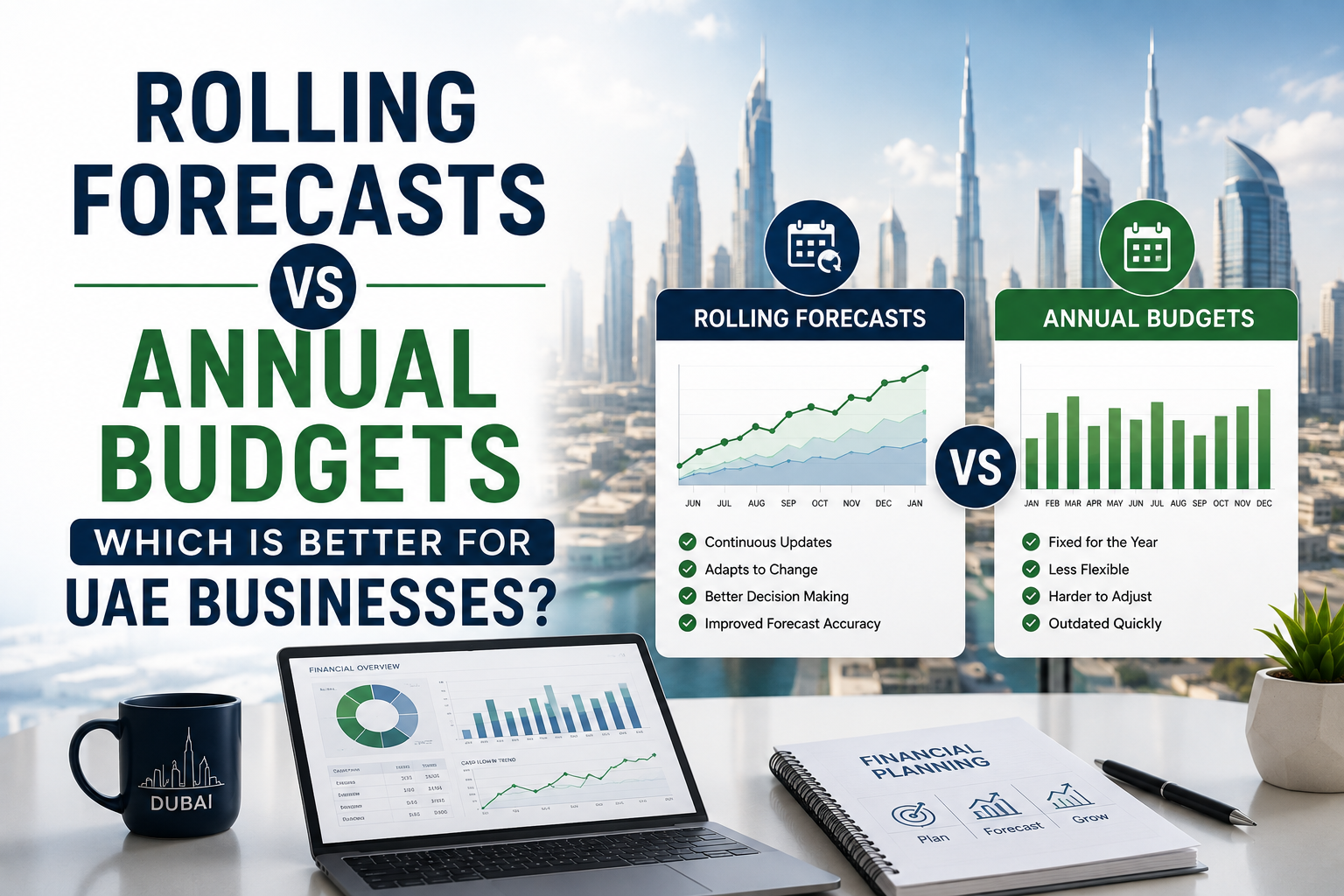
When comparing rolling forecasts vs annual budgets, the main difference is flexibility.
| Annual Budget |
Rolling Forecast |
| Usually prepared once for a financial year |
Updated regularly |
| Provides fixed annual targets |
Provides a continuously changing outlook |
| Useful for financial control |
Useful for ongoing planning |
| Based on assumptions made during budgeting |
Incorporates newer business information |
| Often used for performance measurement |
Often used for decision-making |
| Less flexible when conditions change |
More adaptable to changing conditions |
Neither approach is automatically better for every business.
The right choice depends on the company's size, industry, financial complexity, and planning requirements.
Benefits of Annual Budgets for UAE Businesses
1. Establishes Clear Financial Targets
An annual budget gives management a defined set of financial objectives.
These can include:
- Revenue targets
- Profit margins
- Expense limits
- Hiring budgets
- Capital expenditure
- Departmental targets
Having clearly defined goals can help employees and managers understand the company's financial priorities.
2. Supports Resource Allocation
Businesses have limited financial resources.
An annual budget allows management to decide how those resources should be distributed between different departments and activities.
For example, management can establish specific budgets for:
- Marketing
- Human resources
- Operations
- Technology
- Sales
- Administration
This can help ensure that spending aligns with strategic priorities.
3. Provides a Performance Benchmark
Annual budgets can serve as a baseline for measuring actual performance.
Management can compare actual results with budgeted figures to identify differences in:
- Revenue
- Expenses
- Profit
- Cash flow
This process can help identify areas that require further investigation.
4. Supports Long-Term Planning
Annual budgets can be connected to broader business strategies.
Companies can use them to plan for:
- Expansion
- Hiring
- New products
- Technology investments
- Market development
This makes budgeting an important part of strategic financial planning.
Limitations of Annual Budgets
Despite their benefits, traditional annual budgets can become less effective when business conditions change significantly.
They Can Become Outdated
A budget prepared several months before the start of a financial year may be based on assumptions that no longer reflect current market conditions.
Changes in:
- Customer demand
- Operating costs
- Competition
- Exchange rates
- Business strategy
can make the original assumptions less relevant.
They Can Be Time-Consuming
Preparing a detailed annual budget can require significant time from finance teams and department managers.
They May Encourage Short-Term Thinking
Some organisations focus heavily on meeting annual budget targets rather than adapting quickly to new opportunities or risks.
Benefits of Rolling Forecasts for UAE Businesses
1. Provides a More Current Financial Outlook
Rolling forecasts incorporate new information regularly.
This can give management a clearer view of expected future performance.
For example, if actual sales are significantly higher or lower than expected, the forecast can be adjusted accordingly.
2. Improves Business Agility
UAE businesses operate in markets that can change quickly.
Rolling forecasts allow companies to respond to changing conditions instead of relying entirely on assumptions made months earlier.
3. Supports Better Cash Flow Planning
Because forecasts are continuously updated, management can identify potential changes in future cash requirements.
This can help with:
- Working capital management
- Supplier payments
- Customer collections
- Financing requirements
- Investment decisions
4. Helps Identify Emerging Risks
A rolling forecast can highlight potential problems before they become significant.
For example, declining sales combined with increasing expenses may indicate that the company needs to review its spending or revenue strategy.
5. Supports Scenario Planning
Rolling forecasts can also be used alongside different financial scenarios.
Management may evaluate potential outcomes under:
- Base-case assumptions
- Optimistic assumptions
- Conservative assumptions
This can help businesses prepare for uncertainty.
Limitations of Rolling Forecasts
Rolling forecasts also have some challenges.
Requires Regular Updates
Businesses need reliable financial information and processes to maintain accurate forecasts.
Requires Management Involvement
Finance teams may need regular input from sales, operations, HR, and other departments.
Can Require Better Financial Systems
Businesses with poor-quality financial data may find it difficult to maintain useful rolling forecasts.
Does Not Replace Strategic Planning
A rolling forecast provides an updated financial outlook, but it does not replace a company's long-term strategy or annual objectives.
Which Is Better for UAE Businesses?
The answer to rolling forecasts vs annual budgets depends on what the business is trying to achieve.
An annual budget may be more useful for:
- Setting yearly targets
- Controlling expenditure
- Allocating resources
- Measuring departmental performance
- Establishing financial accountability
A rolling forecast may be more suitable for:
- Managing uncertainty
- Updating financial expectations
- Monitoring cash flow
- Supporting rapid growth
- Adjusting plans as conditions change
For many UAE businesses, the strongest approach may be to use both.
Why Businesses Can Use Annual Budgets and Rolling Forecasts Together
Annual budgets and rolling forecasts do not have to compete with each other.
They can perform different functions within the same financial planning framework.
For example:
Annual Budget → Sets Financial Targets
Rolling Forecast → Updates Future Expectations
Variance Analysis → Compares Actual Results With Plans
This approach allows management to maintain clear annual objectives while also adapting financial expectations as new information becomes available.
How to Combine Both Approaches
Businesses can create an integrated planning process.
Step 1: Prepare the Annual Budget
Set revenue, expense, profit, and investment targets for the year.
Step 2: Establish Key Performance Indicators
Determine the financial and operational metrics that will be monitored.
Step 3: Create a Rolling Forecast
Develop a forward-looking forecast covering the next 12 months or another appropriate period.
Step 4: Update the Forecast Regularly
Incorporate actual results and new business information.
Step 5: Perform Variance Analysis
Compare actual results against the annual budget and rolling forecast.
Step 6: Review Business Assumptions
Identify whether changes in market conditions require adjustments to future projections.
Step 7: Align Financial Decisions With Strategy
Use the updated information to guide spending, investment, hiring, and growth decisions.
Rolling Forecasts for Growing UAE Businesses
Rolling forecasts can be particularly useful for businesses experiencing rapid growth.
A growing company may regularly experience changes in:
- Sales volume
- Employee numbers
- Customer acquisition
- Operating costs
- Inventory requirements
- Capital expenditure
An annual budget may not fully reflect these changes as they occur.
A rolling forecast allows management to update financial expectations and evaluate whether the company's resources remain sufficient to support its growth plans.
Common Mistakes Businesses Should Avoid
When implementing either approach, businesses should avoid several common mistakes.
Treating the Budget as a Fixed Rule
An annual budget should provide direction, but management should still be able to respond to significant changes.
Updating Forecasts Without Reviewing Assumptions
Simply changing numbers without examining the reasons behind them can produce unreliable projections.
Ignoring Cash Flow
Revenue and profitability should not be considered without assessing liquidity.
Using Poor-Quality Data
Forecast accuracy depends heavily on the quality of the financial information being used.
Failing to Involve Departments
Sales, operations, HR, and other departments often provide important information for realistic forecasts.
How Professional Budgeting and Forecasting Support Can Help
Businesses may find it challenging to develop and maintain effective financial planning processes internally.
Professional budgeting and forecasting support can help with:
- Annual budget preparation
- Rolling forecasts
- Cash flow forecasting
- Scenario modelling
- Variance analysis
- Financial projections
- Departmental budgeting
- Working capital forecasting
This can give management greater visibility into both current performance and future financial requirements.
Best Practices for UAE Businesses
Whether a company uses annual budgets, rolling forecasts, or both, several practices can improve financial planning:
- Use accurate and timely financial data.
- Set realistic financial assumptions.
- Review forecasts regularly.
- Monitor cash flow alongside profitability.
- Compare actual results against projections.
- Investigate significant variances.
- Involve relevant departments in forecasting.
- Use different scenarios when uncertainty is high.
- Connect financial plans with business strategy.
- Update financial assumptions when circumstances change.
Conclusion
When comparing rolling forecasts vs annual budgets, UAE businesses should recognise that each approach serves a different purpose. Annual budgets provide clear financial targets and support resource allocation, while rolling forecasts offer greater flexibility by continuously updating future expectations.
For many businesses, combining both methods can provide the best of both worlds. The annual budget can establish strategic and financial targets, while rolling forecasts can help management adapt those plans as new information becomes available.
For UAE companies looking to strengthen their financial planning processes, professional support from Dubai Business and Tax Advisors (DBTA) can help with budgeting, rolling forecasts, cash flow projections, scenario modelling, and financial analysis, allowing businesses to make more informed decisions as their financial needs evolve.




 English