


Boiler Upgrade Scheme vs Boiler Replacement: Costs, Grants & Heating Options Compared
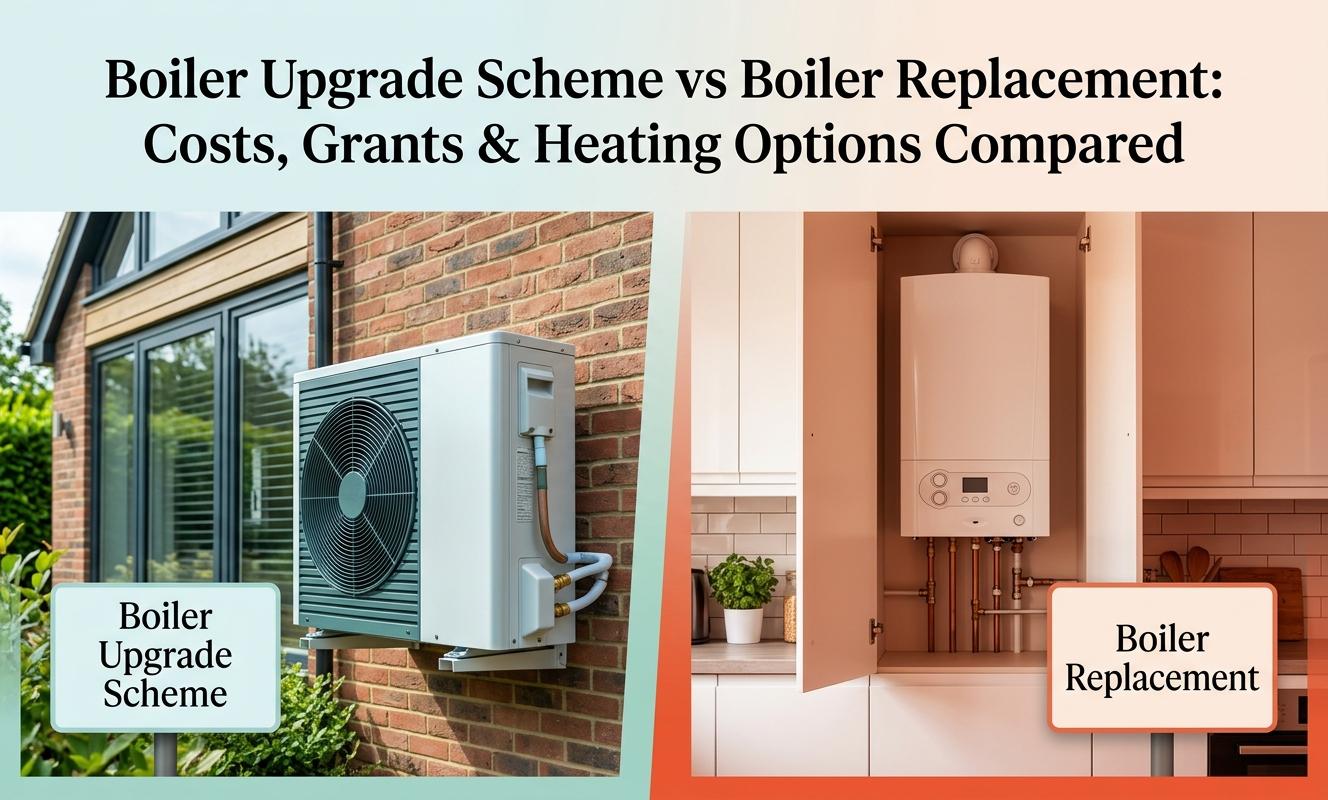
Boiler replacement grant UK options can help eligible homeowners reduce the cost of improving or replacing their heating system. However, a conventional boiler replacement and a Boiler Upgrade Scheme installation are two different routes.
If your existing boiler is old, inefficient or nearing the end of its life, you may be considering whether to install another boiler or switch to a heat pump.
This guide compares boiler replacement vs the Boiler Upgrade Scheme, including costs, grants, eligibility, heating technologies, benefits and the installation process.
Boiler Upgrade Scheme vs Boiler Replacement: At a Glance
| Feature | Boiler Replacement | Boiler Upgrade Scheme |
|---|---|---|
| Main purpose | Replace an existing boiler | Replace eligible heating with low-carbon technology |
| Typical system | Gas, oil or LPG boiler | Heat pump or qualifying biomass boiler |
| Government BUS grant | Not applicable | Available if eligible |
| Standard air-to-water heat pump grant | — | £7,500 |
| Ground-source heat pump grant | — | £7,500 |
| Air-to-air heat pump grant | — | £2,500 |
| Enhanced heat pump grant | — | Up to £9,000 for qualifying properties |
| Application | Depends on funding available | Installer-led |
| Main benefit | Straightforward boiler replacement | Lower-carbon heating with grant support |
The Boiler Upgrade Scheme is available in England and Wales and helps reduce the upfront cost of eligible low-carbon heating installations.
What Is a Boiler Replacement?
A boiler replacement means removing an existing boiler and installing a new conventional boiler.
You may consider replacing your boiler if:
- Your current boiler is old.
- It frequently breaks down.
- Repair costs are increasing.
- Replacement parts are becoming difficult to obtain.
- Your heating system is no longer performing efficiently.
- You want to upgrade to a modern boiler.
A boiler replacement can be a practical option when you want to continue using a conventional heating system.
However, replacing one conventional boiler with another is not the same as applying for the Boiler Upgrade Scheme.
What Is the Boiler Upgrade Scheme?
The Boiler Upgrade Scheme (BUS) is a government scheme designed to help property owners in England and Wales move from eligible fossil-fuel heating systems to qualifying low-carbon heating technologies.
Depending on the property and installation, the scheme can provide support towards:
- Air-to-water heat pumps
- Ground-source heat pumps
- Water-source heat pumps
- Air-to-air heat pumps
- Qualifying biomass boilers
The scheme is designed to reduce the upfront cost of eligible installations.
Boiler Upgrade Scheme vs Boiler Replacement: What's the Difference?
The main difference is the heating technology being installed.
Boiler Replacement
An existing conventional boiler is replaced with another boiler.
Example:
Old gas boiler → New gas boiler
Boiler Upgrade Scheme
An eligible existing heating system is replaced with an approved low-carbon heating system.
Example:
Oil heating → Air-to-water heat pump
The two options therefore have different costs, technologies, eligibility requirements and long-term considerations.
Boiler Upgrade Scheme Grant Amounts in 2026
The current grant structure includes different amounts depending on the technology and property.
| Heating technology | Grant amount |
|---|---|
| Air-to-water heat pump | £7,500 |
| Ground-source heat pump | £7,500 |
| Water-source heat pump | £7,500 |
| Air-to-air heat pump | £2,500 |
| Qualifying off-gas-grid air-to-water heat pump | £9,000 |
| Qualifying off-gas-grid ground-source heat pump | £9,000 |
| Qualifying biomass boiler | £5,000 |
The £9,000 grant applies to qualifying off-gas-grid properties under the current scheme rules. It is not a standard grant available to every homeowner.
The enhanced grant values came into effect from 21 July 2026.
Boiler Upgrade Scheme Grant Comparison
The current grant levels can be visualised simply:
£9,000  ██████████████████  Off-gas-grid heat pump
£7,500  ███████████████      Air-to-water heat pump
£7,500  ███████████████      Ground-source heat pump
£7,500  ███████████████      Water-source heat pump
£5,000  ██████████           Biomass boiler
£2,500  █████                Air-to-air heat pump
The amount you can receive depends on the specific property, heating system and BUS requirements.
Is There a Boiler Replacement Grant in the UK?
There is no single universal grant that automatically pays for every homeowner to replace an old boiler with a new conventional boiler.
Different government and energy-efficiency schemes have different requirements.
The Boiler Upgrade Scheme is specifically focused on eligible low-carbon heating installations.
Therefore:
Old gas boiler → New gas boiler
This would generally be a boiler replacement, rather than a Boiler Upgrade Scheme installation.
Whereas:
Oil heating → Eligible heat pump
may qualify for BUS if the property and installation meet the scheme requirements.
Boiler Replacement vs Heat Pump: Which Is Better?
There is no single solution that is right for every property.
Your decision should consider:
- Existing heating system
- Property size
- Heat demand
- Insulation
- Available space
- Installation requirements
- Budget
- Long-term heating plans
- Grant eligibility
A Boiler Replacement May Be Suitable If:
- Your boiler needs replacing quickly.
- You want to continue using conventional heating.
- Your property is currently designed around a boiler.
- You prefer a familiar heating system.
- A heat pump is not currently suitable for your property.
A Heat Pump Through BUS May Be Suitable If:
- You want to move towards low-carbon heating.
- Your property can accommodate a suitable heat pump.
- You want to use available government grant support.
- You are replacing an eligible existing heating system.
- You are considering a long-term alternative to fossil-fuel heating.
Heat Pump vs Boiler Comparison
| Factor | Conventional Boiler | Heat Pump |
|---|---|---|
| Primary energy | Usually gas, oil or LPG | Electricity |
| Combustion | Yes | No |
| BUS grant | No | Available if eligible |
| Outdoor unit | Usually no | Usually required |
| System design | Conventional boiler design | Heat-pump-specific design |
| Carbon impact | Generally higher | Generally lower |
| Existing radiators | Often retained | May require assessment |
| Installation requirements | Usually familiar | More detailed assessment required |
| Long-term option | Conventional heating | Low-carbon heating |
How Much Does Boiler Replacement Cost?
The cost of replacing a boiler depends on the installation.
Factors that can affect the price include:
- Boiler type
- Boiler size
- Property size
- Location of the boiler
- Flue requirements
- Pipework
- Heating controls
- Cylinder requirements
- Removal of the existing boiler
- Additional installation work
A straightforward replacement may cost less than a more complex heating-system upgrade.
For an accurate price, a property assessment and quotation are recommended.
How Much Does a Heat Pump Installation Cost?
Heat pump installation costs can vary significantly.
The final price can depend on:
- Heat pump type
- Property size
- Heat demand
- Existing radiators
- Insulation
- Pipework
- Hot-water requirements
- Electrical requirements
- Outdoor unit location
- Installation complexity
The Boiler Upgrade Scheme grant reduces the eligible upfront cost, but it does not necessarily cover the complete installation.
Your quotation should clearly show the total installation cost, grant contribution and remaining customer payment.
Boiler Replacement Cost vs Boiler Upgrade Scheme
The basic cost structure is different.
Conventional Boiler Replacement
New Boiler
     +
Installation
     +
Additional Work
     =
Total Boiler Replacement Cost
Boiler Upgrade Scheme Installation
Heat Pump
     +
Installation
     +
Additional Work
     -
BUS Grant
     =
Customer Contribution
This means homeowners should compare the final customer contribution and long-term heating requirements, rather than comparing only the headline installation price.
What Heating Systems Are Covered by the Boiler Upgrade Scheme?
The scheme can support eligible low-carbon heating technologies.
These can include:
- Air-to-water heat pumps
- Ground-source heat pumps
- Water-source heat pumps
- Air-to-air heat pumps
- Biomass boilers in qualifying circumstances
The proposed system must meet the applicable scheme requirements.
Not every heat pump or biomass installation automatically qualifies.
What Existing Heating Systems Can Be Replaced?
Eligible existing heating systems can include certain fossil-fuel or electric heating systems, depending on the current scheme rules.
Examples include:
- Gas heating
- Oil heating
- LPG heating
- Coal heating
- Certain electric heating systems
A low-carbon heating system that is already installed generally cannot simply be replaced using BUS funding.
Who Can Apply for the Boiler Upgrade Scheme?
The scheme is aimed at eligible property owners in England and Wales.
You may be able to qualify if:
- You own the property.
- You are replacing an eligible existing heating system.
- The proposed heating technology is eligible.
- The installation meets the scheme requirements.
- The installer meets the relevant certification requirements.
There are also restrictions for certain properties and previously funded installations.
Properties That May Not Qualify
The scheme has specific exclusions.
These can include:
- Most new-build properties
- Social housing
- Properties that have already received certain government support for a heat pump or biomass boiler
- Installations that do not meet the required technical standards
There are exceptions for certain circumstances, so eligibility should always be assessed against the current scheme rules.
How Does the Boiler Upgrade Scheme Work?
The application process is generally handled by the installer.
1. Property Assessment
The installer reviews your existing heating system and property.
2. Heating System Assessment
The installer considers whether a suitable low-carbon heating system can be installed.
3. Eligibility Check
Your property and proposed installation are checked against BUS requirements.
4. Quotation
You receive a quotation showing the proposed system and expected costs.
5. Grant Application
The installer submits the BUS application through the relevant scheme process.
6. Installation
The approved heating system is installed.
7. Grant Redemption
The installer redeems the grant and applies the approved funding towards the eligible installation cost.
Boiler Upgrade Scheme Eligibility Checklist
Before arranging an installation, consider these key points:
| Requirement | Check |
|---|---|
| Property ownership | ✓ |
| Property located in England or Wales | ✓ |
| Existing eligible heating system | ✓ |
| Proposed low-carbon technology eligible | ✓ |
| Installer meets scheme requirements | ✓ |
| Installation meets technical standards | ✓ |
| Required application process completed | ✓ |
Eligibility should be confirmed before relying on a particular grant amount.
Benefits of Replacing an Old Boiler
A conventional boiler replacement can offer several benefits.
Improved Reliability
A new boiler can reduce problems associated with an ageing heating system.
Modern Controls
New systems can provide improved heating controls and scheduling.
Better Efficiency
A modern boiler can be more efficient than an old, poorly performing system.
Familiar Technology
Homeowners can continue using a heating system they already understand.
Potentially Simple Installation
Where the replacement is straightforward, installation may require fewer changes to the existing heating system.
Benefits of the Boiler Upgrade Scheme
Switching to an eligible low-carbon heating system can provide different advantages.
1. Grant Support
The BUS grant can reduce the upfront cost of an eligible installation.
2. Low-Carbon Heating
Heat pumps can provide an alternative to fossil-fuel heating.
3. Different Technology Options
Eligible homeowners can consider different heat-pump technologies depending on their property.
4. Long-Term Heating Strategy
A heat pump can form part of a longer-term move towards lower-carbon home heating.
5. Professional Assessment
The installer-led process provides an opportunity to assess the property before installation.
What Should You Consider Before Choosing a Heat Pump?
A heat pump should be selected based on the requirements of the property rather than simply the available grant.
Important considerations include:
- Home heat loss
- Insulation
- Radiator performance
- Hot-water requirements
- Outdoor space
- Electrical supply
- Heat pump location
- System controls
- Installation cost
A professional assessment can help determine whether a heat pump is an appropriate option.
Boiler Replacement or Boiler Upgrade Scheme: Which Should You Choose?
Use this quick guide:
| If you... | Consider |
|---|---|
| Need a quick conventional replacement | Boiler replacement |
| Want another gas boiler | Boiler replacement |
| Want to reduce reliance on fossil fuels | Heat pump |
| Want to access BUS funding | Eligible heat pump/low-carbon system |
| Have an oil-heated property | Check enhanced BUS eligibility |
| Live off the gas grid | Check current grant rules |
| Are unsure which system is suitable | Professional heating assessment |
There is no requirement to choose a heat pump simply because a grant is available. The system must be appropriate for your property and heating needs.
Boiler Upgrade Scheme vs Boiler Replacement: Key Takeaways
The main differences can be summarised in five points:
- Boiler replacement normally means installing another conventional boiler.
- Boiler Upgrade Scheme funding supports eligible low-carbon heating technologies.
- BUS grants can reduce the upfront cost of qualifying installations.
- The standard heat-pump grant is £7,500, while qualifying off-gas-grid properties can receive £9,000 for certain heat pumps.
- Your property and proposed installation must meet the relevant scheme requirements.
Boiler Upgrade Scheme FAQs
1. Is the Boiler Upgrade Scheme the same as a boiler replacement grant?
No. The Boiler Upgrade Scheme supports eligible low-carbon heating installations. It is not a general grant for replacing an old gas boiler with another conventional gas boiler.
2. How much is the Boiler Upgrade Scheme grant in 2026?
The current standard grant is £7,500 for eligible air-to-water, ground-source and water-source heat pumps. The grant for eligible air-to-air heat pumps is £2,500.
Certain qualifying off-gas-grid properties can receive £9,000 for eligible air-to-water or ground-source heat pumps.
3. Can I replace my gas boiler with a heat pump?
Yes, potentially. If your property and proposed installation meet the current scheme requirements, an eligible heat pump may qualify for BUS support.
4. Can I get £9,000 towards a heat pump?
Some qualifying off-gas-grid properties can receive £9,000 towards an eligible air-to-water or ground-source heat pump.
The £9,000 amount does not apply automatically to every property.
5. Can I get a Boiler Upgrade Scheme grant for a new gas boiler?
No. BUS is designed to support eligible low-carbon heating technologies rather than conventional gas boiler replacements.
6. Is the Boiler Upgrade Scheme available throughout the UK?
No. The scheme is available in England and Wales. Other parts of the UK have different heating and energy-efficiency support arrangements.
7. Do I apply for the Boiler Upgrade Scheme myself?
The BUS process is installer-led. An eligible installer handles the relevant grant application and redemption process.
8. Can I get BUS if my home has already had insulation work?
Previous energy-efficiency improvements do not automatically prevent eligibility. Your property and proposed installation must still meet the current BUS requirements.
9. Is a heat pump always better than a new boiler?
Not necessarily. The right choice depends on your property, heating requirements, budget, existing system and suitability for low-carbon heating.
10. How do I know which heating system is right for my home?
A professional property and heating assessment can help compare a conventional boiler replacement with an eligible heat-pump installation.
Choose the Right Heating Upgrade for Your Home
Replacing an old boiler does not necessarily mean installing another boiler.
For homeowners who want a conventional solution, a boiler replacement can provide a familiar and practical heating option. For those looking to move towards low-carbon heating, the Boiler Upgrade Scheme can help reduce the upfront cost of an eligible heat-pump installation.
The right choice depends on your property, existing heating system, budget and long-term heating requirements.
British Energy Services can help you explore your heating options and determine the most suitable route for your property.
Ready to Upgrade Your Heating?
Get in touch with British Energy Services to discuss your current heating system, available options and whether a Boiler Upgrade Scheme installation could be suitable for your property.
Final Boiler Upgrade Scheme Eligibility Checklist
Before Boiler Upgrade Scheme Eligibility proceeding, make sure you have considered:
- Do you own the property?
- Is your property in England or Wales?
- Are you replacing an eligible existing heating system?
- Is your proposed heating technology eligible?
- Does the installation meet the scheme requirements?
- Is your installer appropriately certified for the scheme?
- Have you received a clear quotation showing the grant and your contribution?
- Have you confirmed the current grant amount applicable to your property?

 English